
In the rapidly evolving landscape of AI-assisted software development, agility is everything. Yet, many development teams find themselves trapped in single-vendor ecosystems, forced to compromise when their chosen AI model struggles with a specific language, context size, or reasoning task.
Enter the new, beautiful qmax-code interface. We’ve redesigned the terminal experience not just for aesthetics, but to solve a critical commercial bottleneck: frictionless model mobility.
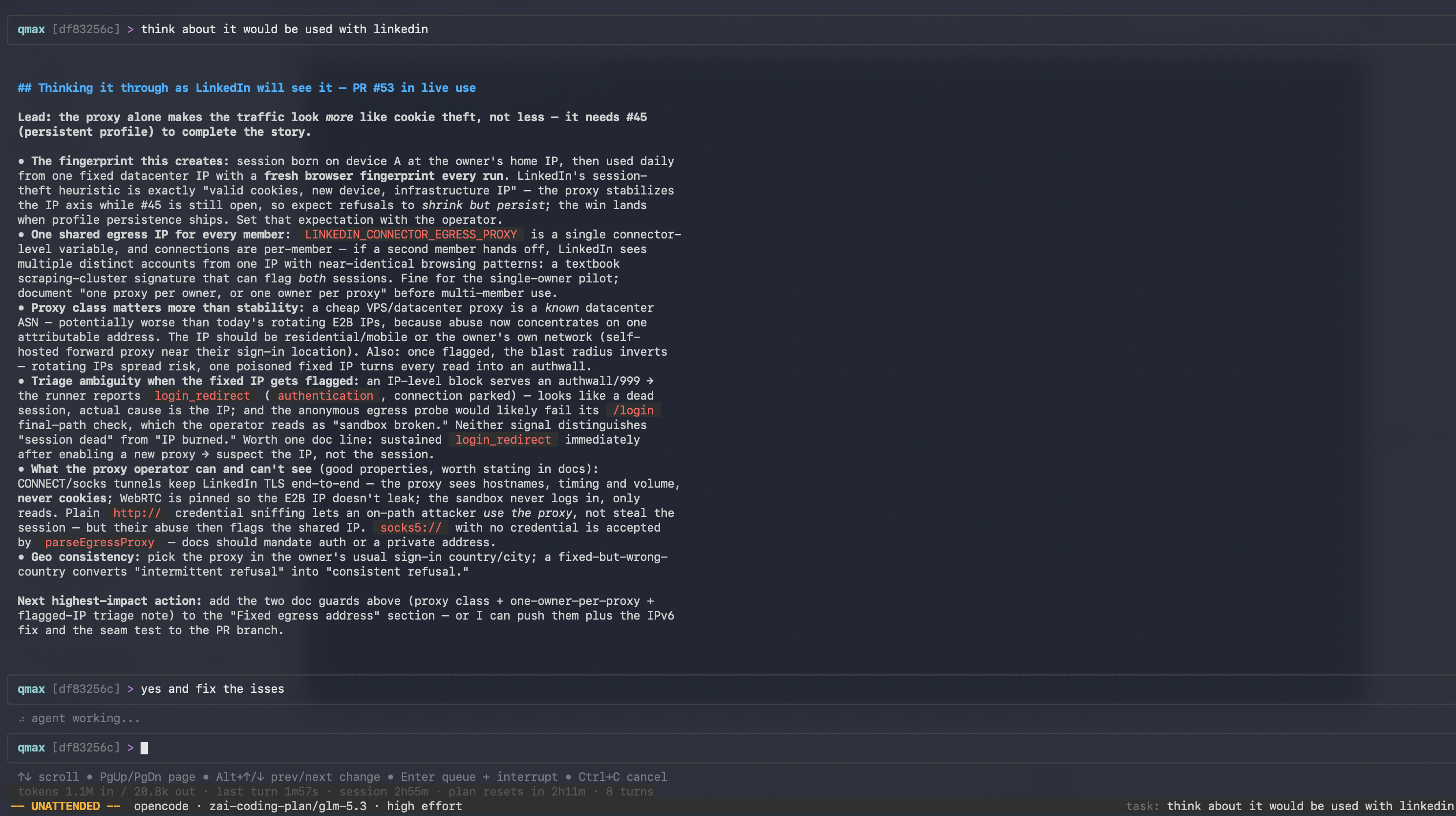
The Multi-Provider Reality
No single AI provider is the best at everything all the time. Sometimes you need the deep contextual understanding of Gemini 3.1 Pro running securely via your Google AI subscription. Other times, you need the blazing fast, code-optimized inference of GLM 5.3 on the Z.AI Coding Plan.
Historically, switching between these required juggling API keys, restarting backend services, or copy-pasting code between different browser tabs. It was a context-switching nightmare that destroyed developer flow.
Effortless Switching in qmax-code
As you can see in our latest TUI updates, qmax-code makes provider lock-in a thing of the past. By hitting a single hotkey, developers are presented with a unified, categorized model selector:
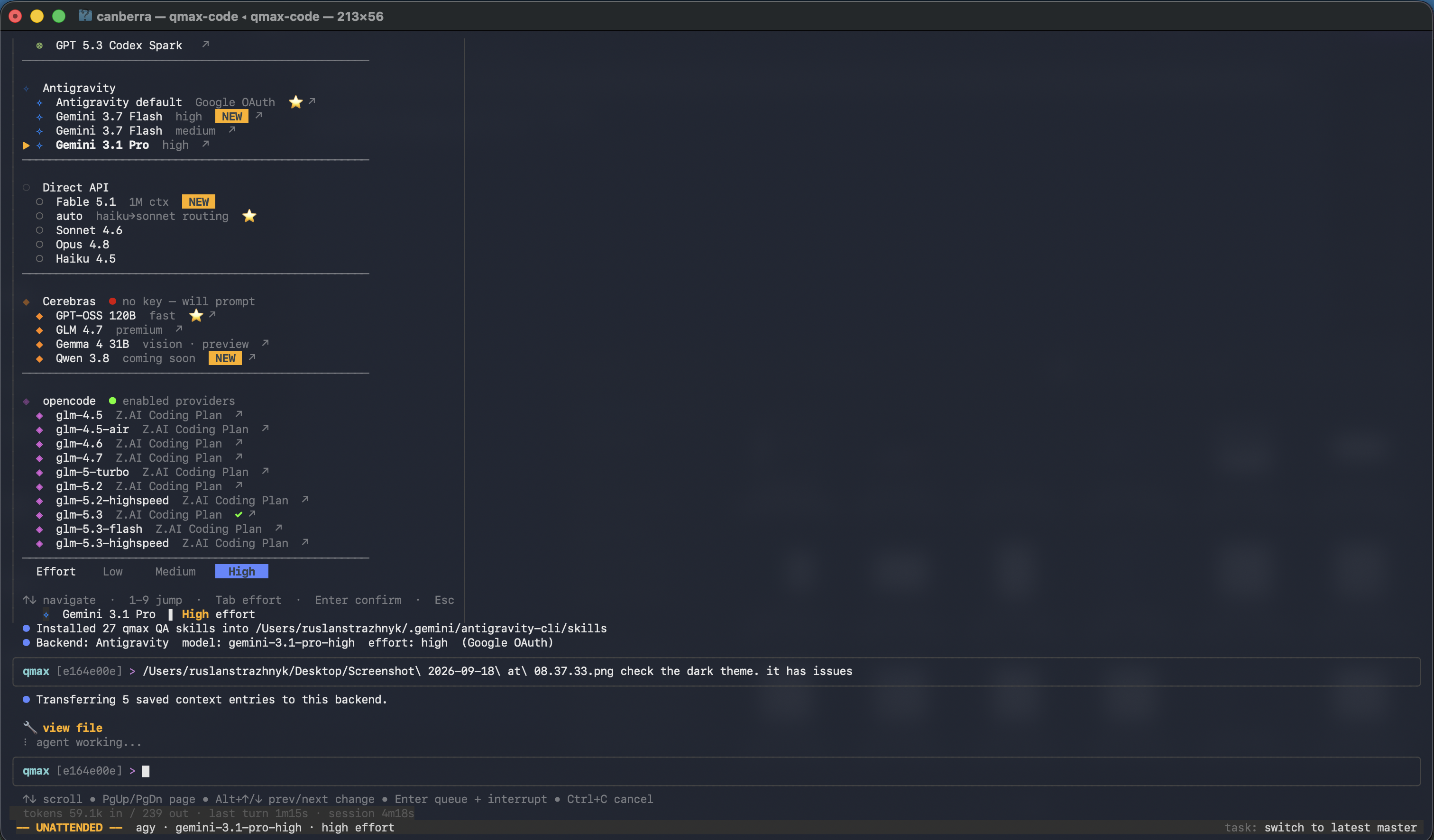
- Antigravity: Connect your qmax-code terminal to the Antigravity MCP client, gaining authenticated access to the Gemini family (3.7 Flash, 3.1 Pro) via Google OAuth.
- opencode: Connect to the opencode MCP client, instantly leveraging your Z.AI Coding Plan for the entire GLM 5 series (from turbo to highspeed).
- Direct API & Cerebras: Fallbacks and bleeding-edge OSS models for specialized workloads configured directly in your runner.
Switching from an architecture planning session with gemini-3.1-pro-high to a rapid refactoring loop with glm-5.3 takes exactly two keystrokes. The active backend, model, and effort tier (Low/Medium/High) are clearly displayed in the status bar, ensuring you always know exactly what compute is driving your session.
The Commercial Advantage
Why does this matter for your engineering organization?
- Cost Optimization: Route simple boilerplate generation to cheaper, faster models while reserving heavy-duty models for complex architectural problem-solving.
- Uninterrupted Flow: Managed subscriptions (Google OAuth, Z.AI) are handled transparently by connected MCP clients (Antigravity and opencode). Developers don't manage keys; they just code.
- Future-Proofing: When a new state-of-the-art model drops, your team can leverage it instantly within the same familiar, powerful TUI.
The beautiful new qmax-code isn't just a terminal UI—it's an orchestration layer for your team's AI compute. Stop fighting your tooling, and start choosing the best AI for the job, exactly when you need it.