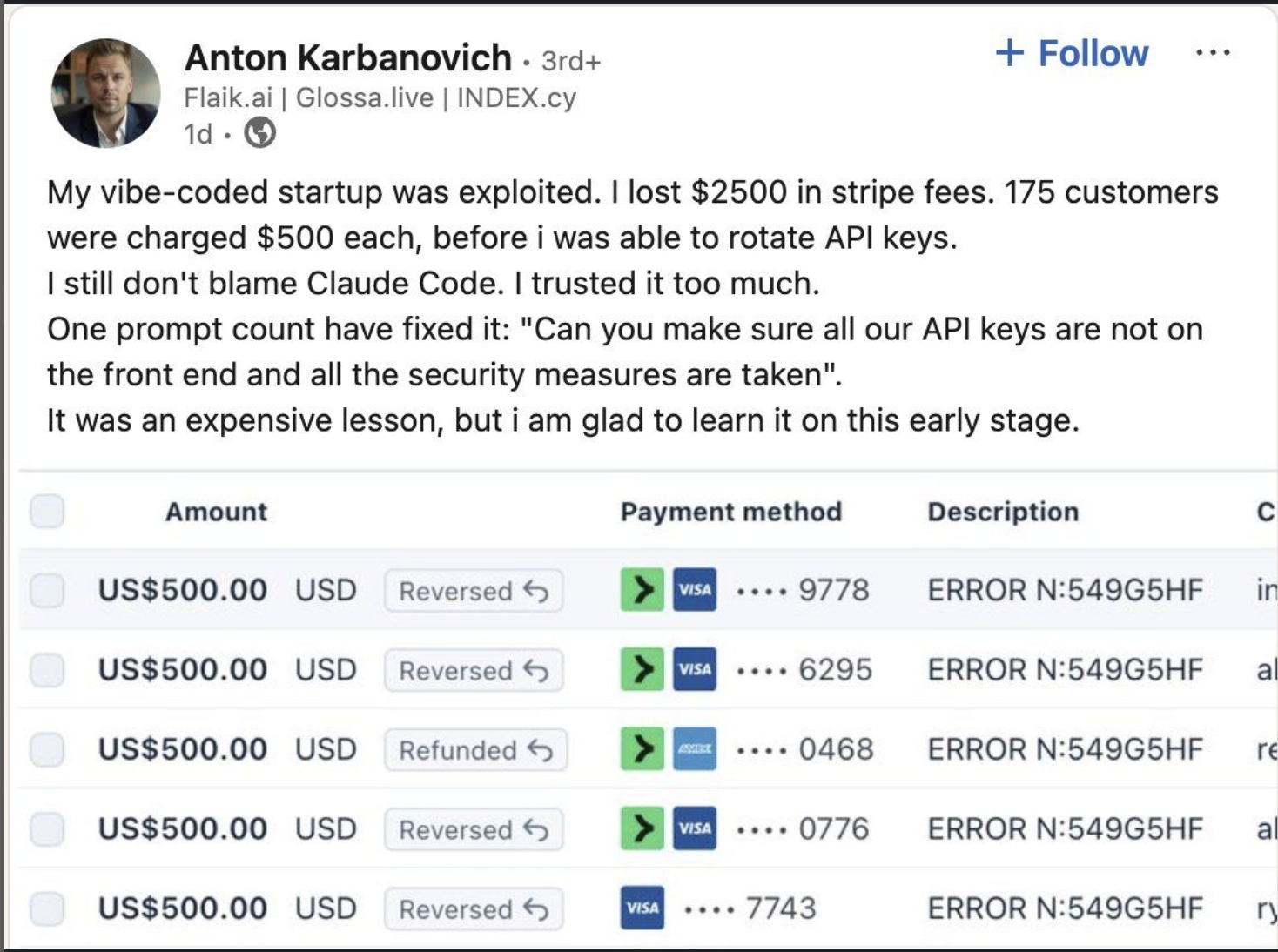
A founder built his startup with Claude Code and shipped it live.
He skipped the security audit. He trusted the AI to handle it.
The fix would have been one sentence.
This happened in March 2026. The founder posted about it publicly on LinkedIn. 247 reactions. 111 comments. Read the original post.
A founder built his entire startup with Claude Code and shipped it live. Payment processing via Stripe. No security audit. No architecture review. Just prompts and production deployment.
He trusted the AI to handle security because it handled everything else.
// TODO: move to env variables before launch
export const config = {
  stripeKey: "sk_live_51N...full_secret_key",  // Stripe SECRET key
  openaiKey: "sk-proj-...full_api_key",       // No spending limit
  dbUrl: "postgresql://admin:pass@db.xxx.com/prod"
}
API keys sat on the front end where anyone could take them.
It didn't take a sophisticated attack. Someone opened DevTools, saw the Stripe secret key in the JavaScript source, and started creating charges.
sk_live_ key in plain textNo brute force. No zero-day. Just a Stripe key sitting in the frontend where anyone could copy it.
"Make sure all API keys are not on the front end
and all security measures are taken."
That's it. One sentence. AI cannot design systems — it only answers the questions you think to ask.
This founder learned at $2,500 in fees. Others are learning at $200K+ in rebuild costs, 4–8 months of re-architecture, and customers who never come back.
Vibe coding created a generation of startups that shipped prototypes as products. The cleanup is coming.
QualityMax would have caught every single vulnerability before a single user signed up. Here's the actual output.
QualityMax crawls your app like an attacker would — but before launch. AI-generated security tests catch exposed keys, broken auth, missing protections, and OWASP Top 10 vulnerabilities automatically.
We recreated the exact vulnerabilities found in real breached vibe-coded startups. Same patterns, same mistakes. Open it, inspect the source, find the secrets.
Then watch QualityMax catch every single one.
A realistic replica of a vibe-coded fintech SaaS, built from patterns found in real breached startups. 24 vulnerabilities — Stripe keys in source, exposed admin panel, leaky API endpoints, XSS, no CSRF. Every flaw was found in actual post-breach investigations.
Open the app →Full customer database with PII, system credentials, API keys, and audit logs. Zero authentication required. This is what attackers find.
Open admin panel →340 user records with names, emails, phones, addresses, partial SSN — all returned as a single JSON response with no auth.
View raw data →Full security scan output: 6 CRITICAL, 8 HIGH, 5 MEDIUM, 3 LOW findings. Every vulnerability cataloged with fix instructions and OWASP references.
View scan results →We auto-generated Playwright test scripts that detect every vulnerability. Run them yourself, or let us run them live right now:
# Or run locally — same tests, same results
npx playwright test demo-vulnerable/qualitymax-tests/ --reporter=list

# Expected output: 25 tests, 25 failures (every vulnerability caught)
  FAIL  test-exposed-secrets.spec.js > Stripe secret key should not be in page source
  FAIL  test-exposed-secrets.spec.js > Supabase service_role key in client bundle
  FAIL  test-exposed-secrets.spec.js > OpenAI API key should not be in client code
  FAIL  test-security-headers.spec.js > Admin panel should require authentication
  FAIL  test-security-headers.spec.js > Content-Security-Policy header should be present
... 20 more failuresThese aren't hypotheticals. These are real founders who posted publicly about what happened when they shipped vibe-coded apps to production.
"My vibe-coded startup was exploited. I lost $2500 in stripe fees. 175 customers were charged $500 each, before i was able to rotate API keys. I still don't blame Claude Code. I trusted it too much. One prompt could have fixed it: 'Can you make sure all our API keys are not on the front end and all the security measures are taken.' It was an expensive lesson, but i am glad to learn it on this early stage."
March 2026 · LinkedIn"This is happening to multiple founders every week. The AI writes code that works but doesn't think about attack surfaces. It only answers what you ask."
"I found 3 exposed Stripe keys on ProductHunt launches last month alone. The founders had no idea. All vibe-coded. All shipped without a single security test."
"The scary part is most founders don't even know they've been breached. They find out when Stripe freezes their account or when a customer calls screaming about a $500 charge."
"I vibe-coded an MVP in 2 days. Took 3 months to clean up the security debt. Database credentials in the client bundle, no rate limiting, admin panel wide open. The AI never warned me once."
Every item above was found in real post-breach investigations. Source: public LinkedIn and HN post-mortems, 2025–2026.
Answer honestly. Every "yes" adds to your risk exposure.
Founder shipped Claude Code app with Stripe secret key on frontend. 175 customers charged $500 each before he could rotate keys.
LinkedIn, March 2026Exposed API key with no spending limit used to run a GPT-4 proxy. Founder discovered it when the monthly bill arrived.
Twitter/X, 20254–8 months of re-architecture. The rebuild cost more than hiring engineers would have from day one. Customers never came back.
Hacker News, 2025Healthcare startup leaked patient records through unsecured API endpoint. HIPAA violation led to forced shutdown.
HHS Breach Portal, 2025No setup. No configuration. Just paste your URL.
QualityMax's AI crawler scans every page, API endpoint, and JavaScript bundle — exactly like an attacker would.
Exposed secrets, broken auth, missing headers, OWASP Top 10 vulnerabilities — all flagged with severity and fix instructions.
AI generates Playwright security tests you can run in CI/CD. Every deploy is checked. Every vulnerability is caught.
Every shortcut in development becomes a liability in production. The only question is whether you find the holes first, or someone else does.
Free tier includes security crawl, vulnerability report, and test generation. No credit card required.