
Vibe coding won. You describe, the agent builds, the app exists by dinner. We’re not here to lecture you about it — we build QualityMax the same way. Sixty agent-written PRs shipped our new billing system in three weeks.
But there’s a tax on unreviewed vibes. A founder we wrote about vibe-coded a fintech app, shipped it with API keys in the frontend, and watched 175 customers get charged $500 each before he could rotate the keys. $87,500. One review pass would have caught it. And no, the agent that wrote the code won’t catch it — you can’t review your own work, and neither can your model, no matter how nicely you ask it to double-check.
TL;DR
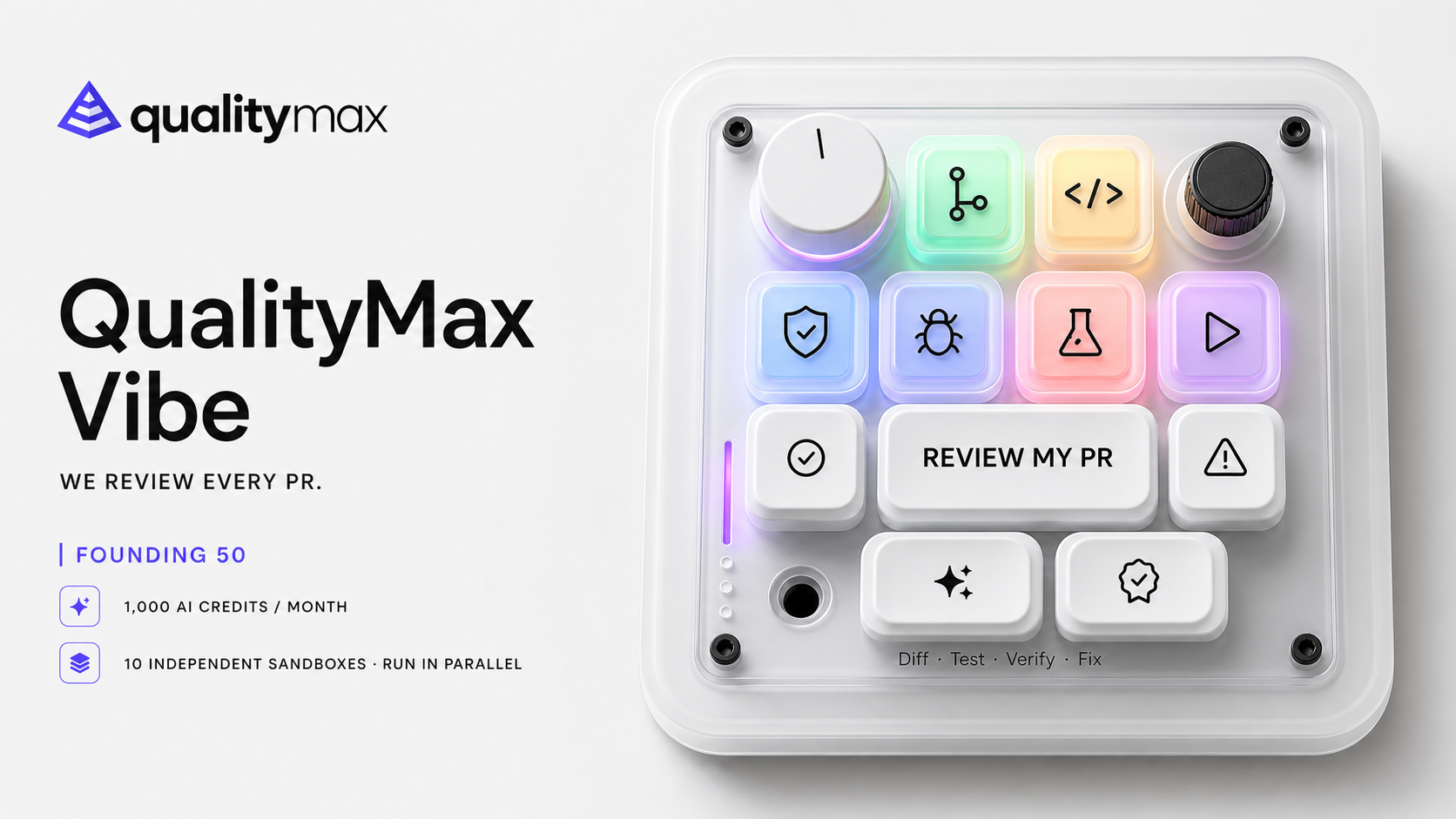
Vibe is the plan built for exactly this split: generation stays on your own Claude Code, Codex, or API keys — review moves to an independent AI gate with receipts. €19.99/month, 1,000 monthly AI credits for the first 50 users, 1,000 cloud sandbox minutes, 10 projects.
The division of labor
The plan draws one line and keeps it clean: the AI that writes your code should not be the AI that approves it.
Your side — your AI, your keys
- Claude Code, Codex, or any API key you already pay for
- Generate features, tests, and fixes at whatever pace you like
- Unlimited local test execution
- qmax-code terminal agent, bring-your-own keys
Our side — the independent gate
- AI diff review + SAST on every PR, with BLOCK teeth
- Canonical review cards with proof labels and receipts
- A Finding Verifier that kills false positives before you see them
- Cloud sandbox runs for your generated tests
We just published what this reviewer did to our own billing PRs: 25 BLOCK verdicts across 60 PRs, including a four-round exchange where it caught a missing authorization check, then the ownership gap in the fix, then the race condition in the next fix, then a privilege hole in the fix after that. Twenty minutes, four layers, production billing code. That’s the reviewer Vibe puts on your repository.
Recent receipts, sanitized
These are real findings from QualityMax PRs merged in July 2026, not invented demos. We removed internal filenames, account details, provider identifiers, and operational context; the failure modes and the changes made before merge are preserved.
A file path became a shell command
ReproducedFound: an internal billing-validation tool interpolated a caller-controlled path into shell commands at three call sites, creating a command-injection path.
Changed before merge: the commands were rebuilt with argument-based process execution, removing shell interpretation while preserving the workflow.
An elevated quota operation trusted the target ID
Accepted & fixedFound: multi-tenant quota functions could run with elevated database privileges without binding the requested account to the authenticated caller. The contract did not prevent one account’s request from altering another account’s usage state.
Changed before merge: the operations were moved to caller-aware execution, service callers were explicitly guarded, and privilege plus concurrency coverage was added.
A destructive release lacked an ownership boundary
Accepted & fixedFound: an automated remediation flow released a work claim using only two record identifiers. The contract did not prove that the claim belonged to the current workflow owner.
Changed before merge: ownership was made explicit, the release became atomic, and the privileged invocation was restricted to the trusted service path.
What €19.99 actually buys
Greptile and CodeRabbit review. Why choose Vibe?
Greptile’s strength is full-codebase graph context. CodeRabbit’s is a broad PR workflow with summaries, SAST integrations, autofix, and higher-tier planning tools. Those are real strengths. Vibe makes a sharper bet for AI-heavy builders: you already have Claude Code, Codex, or your own models for generation. What you need is an independent gate with proof, enforcement, and somewhere to run the tests.
| Compare | QualityMax Vibe | Greptile | CodeRabbit |
|---|---|---|---|
| Listed price | €19.99/month or €199.90/year for the whole Vibe plan. | Pro lists $30 per active developer/month. | Pro lists $30/developer month-to-month or $24/month annually; Pro+ lists $60 or $48. |
| Included capacity | 1,000 monthly AI credits for the first 50 users, plus 1,000 cloud-sandbox minutes and 10 projects. | 50 credits per seat; a standard review uses one, a TREX runtime review uses three, and additional credits list at $1 each. | Pro allows five PR reviews per developer per hour; Pro+ allows ten. A usage add-on can continue beyond plan limits. |
| Proof | Proof-labeled findings distinguish reproduced, grounded, and model-only evidence; a verifier suppresses false positives before delivery. | Emphasizes whole-codebase graph context, inline suggestions, conversation, and learning from reactions. | Emphasizes contextual PR reviews, linters/SAST support, chat, reports, and autofix. |
| Execution | 1,000 bundled cloud minutes, with up to ten tests running in parallel, plus unlimited local execution. | TREX runtime validation is available in public beta and consumes three credits per run. | Pro+ advertises unit-test generation; its public plan comparison does not list bundled cloud-sandbox minutes. |
| At the limit | Fails loud: an exhausted AI gate returns an explicit action-required state instead of silently approving the PR. | When a configured flex-spend cap is reached, new flex reviews are skipped until reset or the cap is raised. | Hourly review limits refill over time; paid organizations can enable the usage-based add-on to continue. |
The blunt version
- Choose Greptile when codebase-graph retrieval is the main thing you are buying.
- Choose CodeRabbit when you want a broad, polished review assistant and are comfortable with per-developer pricing and hourly limits.
- Choose Vibe when agents ship most of your code and you want a separate system to prove findings, block unsafe changes, and run the resulting tests — without paying for another coding model seat.
Competitor details checked against official public documentation on July 21, 2026: Greptile pricing, Greptile billing, Greptile features, CodeRabbit pricing, and CodeRabbit plan limits.
Some fine print we’re proud of, because it’s enforced in code, not in marketing copy:
- Deterministic checks are free. SAST and other non-LLM analysis don’t consume credits. Credits meter the LLM-backed review work only.
- Running out is loud, not silent. If your credits are exhausted, the gate returns an explicit action-required state. An AI gate that silently passes when the meter runs out would be worse than no gate — so ours doesn’t.
- Your keys stay yours. Generation through your own Claude Code or Codex seat never touches our credits, and we attribute the source explicitly.
Try it before the vibe check fails
Every new account starts with a 7-day trial that includes 250 hosted-AI credits — enough to see the reviewer work on your real PRs — plus 250 sandbox minutes. During the trial you don’t need Claude Code, Codex, or any API key: we host the AI so you can evaluate the gate itself.
The ladder above Vibe is simple: Studio (€79/month) adds hosted AI for everything — crawling, generation, healing — plus performance testing, Agentic Eyes, full site audits, observability connections, and mobile testing. Free stays free, and Enterprise is a conversation. But if you vibe code, Vibe is the seatbelt: it doesn’t slow the car, it just means the crash doesn’t cost $87,500.
Keep the vibe. Add the gate.
Connect a repo, open a PR, and watch the reviewer that blocks our own billing code review yours. Free for 7 days, no keys required.
Choose Vibe →