
September has a familiar rhythm: school starts, calendars fill up, and everyone tries to find their routine again. We kept building. This month, the question behind much of our work was simple: how do you let an AI help with QA without asking the team to take its word for it?
QualityMax joined the team conversation
We brought QualityMax into Slack. In a channel where the bot is invited, a linked teammate can ask about authorized project records, talk to a Nexus specialist, and propose supported test actions. Follow-up replies stay in the thread. Consequential operations use explicit, scoped approvals rather than interpreting a casual chat reply as permission to change a test or run it.
The point is not to turn every Slack message into an automation command. It is to put the relevant test, result, and approval in the same conversation, with the project and person still determining what is allowed.
One QA terminal, more choice
qmax-code 1.32 expanded its model lineup, and we made switching models a visible part of the workflow. By September 26, qmax-code 1.37 had added Opus 5.5 to the Claude Code and Direct API pickers, along with an optional CLI tool-call narration setting and a safeguard against leaking secrets through that narration. Different QA jobs call for different strengths: a quick inventory, a careful code review, or a long debugging session should not require the same inference choice.
Test intent should travel with you
We added a portable QTML export preview for project and test-case intent. It captures reviewable contracts and structured assertions instead of reducing a project to a pile of generated scripts. The preview is currently limited to QualityMax owner accounts; it is not a full account backup, and it does not include run history or binary artifacts. We also improved execution-history filtering and search so teams can find the runs behind a claim before drawing conclusions.
Jev decisions need receipts
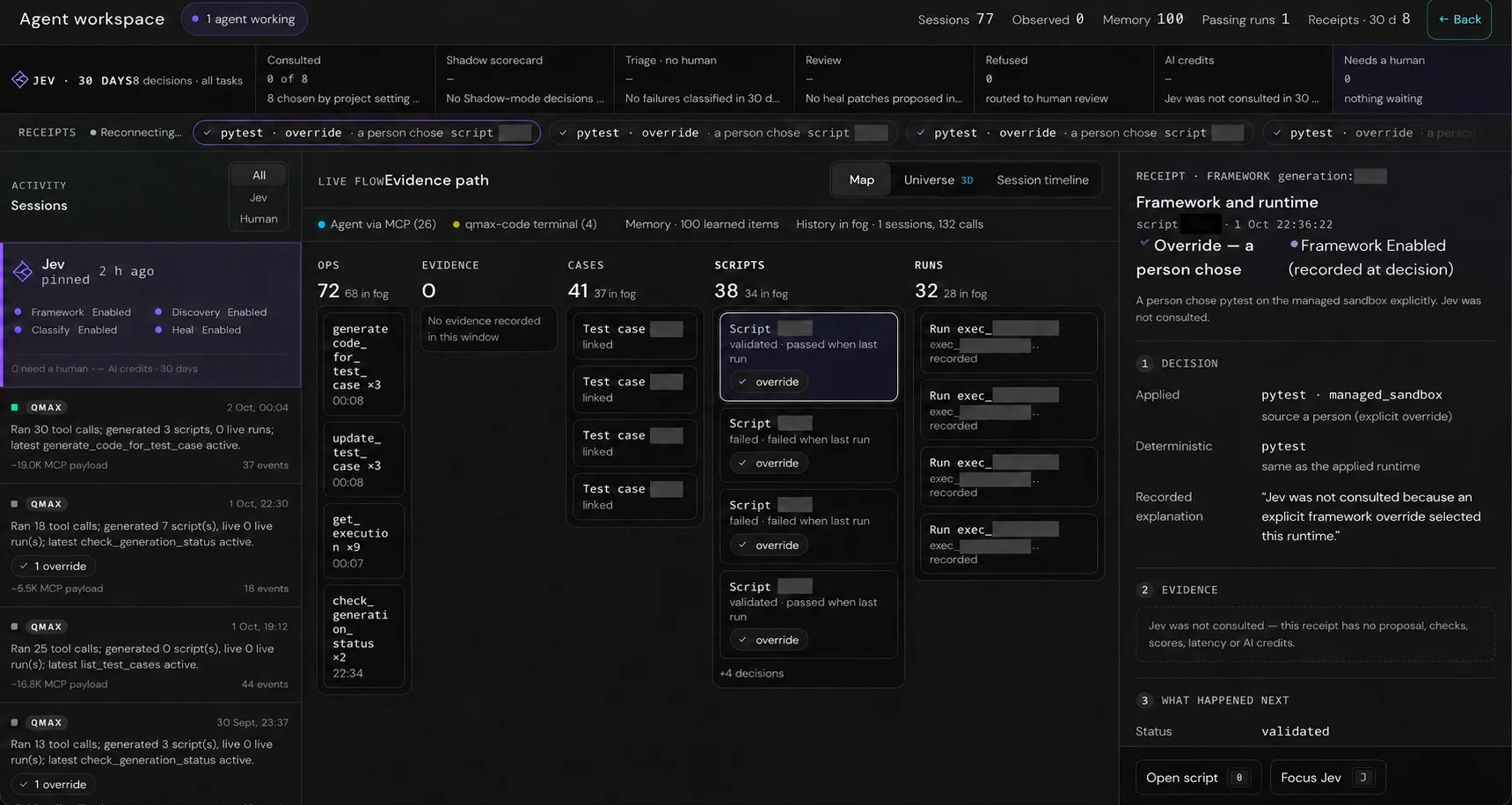
Late in the month we built out Jev's bounded decisions for web testing: framework selection, discovery grounding, failure classification, and healing candidate selection. The controls distinguish Off, Shadow, and Enabled. Shadow records a proposal without applying it; Enabled still passes through independent policy and verification checks. The Jev Live project panel and Sessions workspace make decision activity inspectable, including when Jev was not consulted.
Jev availability: Jev is available on all paid plans. It is also currently enabled for Free plans at no charge through the end of 2026. Each project's decision mode still determines whether Jev's suggestions can be applied.
That distinction matters. A generated script is not a passing execution. A proposed repair is not an applied patch. An applied patch is not proof the latest version still behaves correctly. We wrote more about the gap between an agent's confident story and the evidence behind it in When an AI Agent Said Jev Fixed the Tests.
What ties the month together
Slack made QA work easier to discuss. qmax-code gave teams more control over the model doing that work. QTML made test intent more portable. Jev and the Sessions workspace made AI decisions easier to inspect. None of those replaces a real run against the right target, but together they make the path from idea to evidence much clearer.
Thanks for building with us through September. If there is a workflow that still makes you leave the test, its context, or its evidence behind, tell us. That is exactly the kind of gap we want to close next.
Keep building with QualityMax
Highest possible quality AI test automation awaits you! Bring tests, runs, and reviewable evidence into the workflow your team already uses.
Get started →